 Darb
DarbWhy Do Payment Technologies Get Adopted?
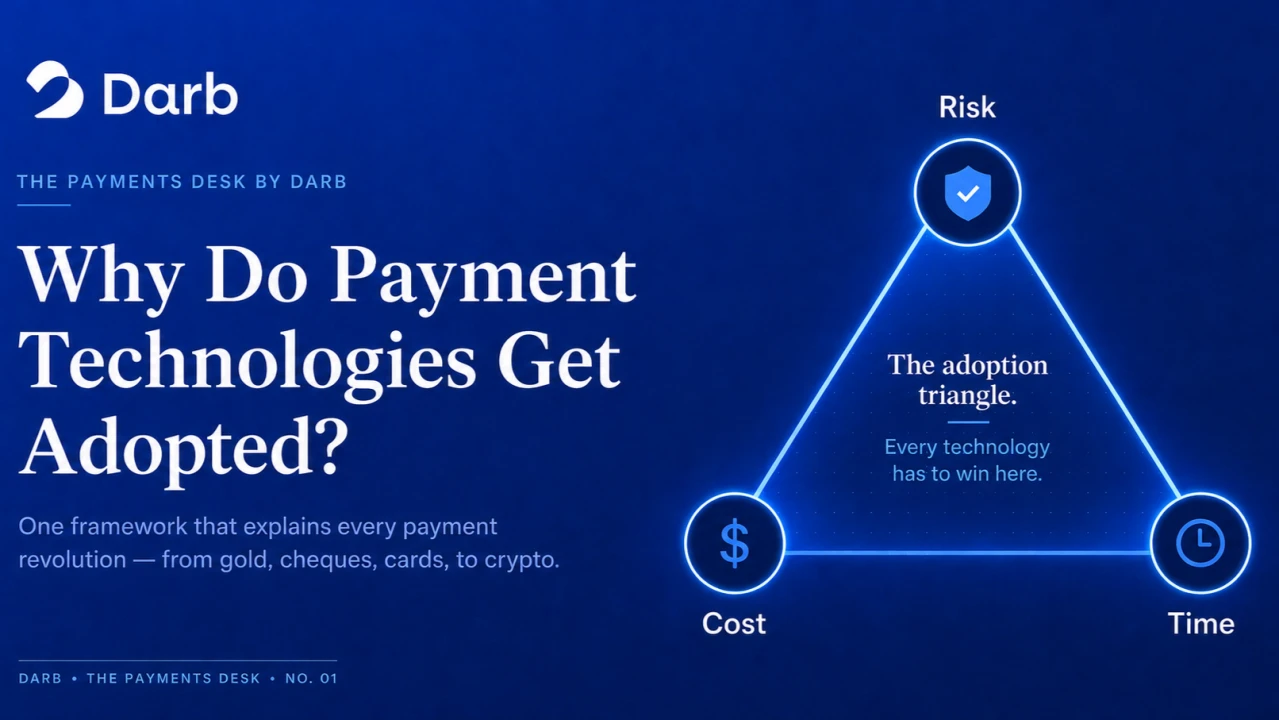
Risk, cost and time: a framework for understanding the adoption of cheques, cards and stablecoins—and how it guides product decisions at Darb.
Abdulmohsen Al Babtain, Founder & CEO of Darb
For five years I watched billions of riyals move from customers to merchants, and spoke to every party in the chain: the customer, both banks and their processors, the scheme, and the gateway. Six layers, one transaction. Leading product and engineering at Tamara put me in the middle of all of it, and I fell in love with payments.
They look effortless—that familiar Apple Pay sound—but underneath sits enormous complexity. Over those years I noticed that payment revolutions tend to pass the same test.
The payment triangle
A payment moves money from A to B. Even lending depends on a way to be repaid. To understand a new payment technology, I look at three dimensions.
Risk: does it make moving money safer?
Cost: does it reduce the total cost, ideally for both sides?
Time: does it make payment or settlement faster?
My working rule is that, to win at scale, a new way to pay needs a clear improvement on at least two of the three. Improve all three and it has the potential to change the market.
There is an important caveat: the corners are not equal. A severe deterioration in any one dimension can undermine a product even if it improves the other two. Keep that in mind when we get to cryptocurrency.
Cheques: moving a claim instead of moving gold
The Arabic ṣakk (صك), a written order to pay, is an early example of the idea behind a cheque. Merchants used written claims in the early Islamic world to move value without carrying the corresponding gold on every journey.
The principle was simple: deposit gold in one city, carry a written claim across the desert, and redeem it in another. The broader idea—transferring a claim instead of the underlying asset—also helps explain the role of banknotes in later payment systems.
Against transporting gold, the triangle looks like this.
Risk: an improvement. The traveller no longer carries a fortune that can be stolen, and has less exposure to counterfeit or clipped coins. Trust in the issuer and redemption process still matters.
Cost: broadly neutral. Redemption may carry a fee, but guarding, insuring and weighing the metal also have costs.
Time: an improvement. There is less need to transport and weigh physical metal at each stop.
Verdict: clear gains in risk and time. A useful early example of why a payment method can earn adoption.
Cards: payment access without carrying cash
Cards have an unusual history: one of their best-known early forms was a credit product. Frank McNamara's Diners Club, introduced in 1950, was a charge card, with the balance repaid monthly. BankAmericard followed in 1958 with revolving credit and later became Visa.
Against cash, the gains are more nuanced than they first appear.
Risk: generally an improvement. A lost card can be frozen. Carrying access to funds is different from carrying the funds themselves. Fraud protection and dispute processes can add safeguards, subject to the card's terms.
Cost: it depends on which side you ask. A cardholder may face little or no direct transaction cost, while the merchant pays an acceptance fee. Merchant pricing varies by network, provider and transaction type. Cards can also support more sales, which changes the overall commercial calculation.
Time: an improvement at checkout. Authorisation can be immediate, and merchants avoid some of the work of handling and depositing cash. Authorisation is not settlement, however: merchants often receive funds later, depending on the arrangement.
Verdict: a strong improvement in risk and checkout speed, with a workable economic model on both sides. That combination supported widespread adoption.
Cryptocurrency: payment and settlement are not the same problem
Cryptocurrency covers two distinct ideas: volatile assets such as Bitcoin, and stablecoins designed to track a currency. For this payment comparison, stablecoins are the more relevant case.
Against cards and conventional money, their advantages come with meaningful trade-offs.
Risk: a concern for many users. A stablecoin reduces price volatility only while its peg holds. Terra's collapse and USDC's temporary depeg in 2023 illustrate different forms of that risk. There is generally no card-style chargeback: an incorrect transfer may be irreversible. Self-custody adds responsibility for securing keys; custodial platforms introduce counterparty risk. Failures such as Mt. Gox and FTX were failures of intermediaries, not proof that offline key storage itself is unsafe.
Cost: an advantage in some cases, not all. Large cross-border transfers can benefit, but network fees vary and converting between fiat and stablecoins adds cost and operational friction.
Time: a genuine strength. Some networks support rapid, round-the-clock settlement, rather than waiting for conventional settlement cycles. Actual finality and timing depend on the network and the service used. The irreversibility that worries a consumer can be valuable in a settlement context.
Why has that not translated into universal everyday use? In my view, the cost advantage is conditional and the risk burden remains substantial for many users. A serious loss on one corner can outweigh progress elsewhere.
Verdict: a promising settlement technology, but a more difficult proposition for everyday consumer payments. The triangle helps explain the distinction.
An honest limitation: the network matters
The triangle helps explain which technologies deserve consideration. It does not guarantee which will win. Payments are two-sided: customers will not use what merchants do not accept, and merchants will not accept what customers do not use.
That network problem sits on top of the triangle. It is one reason cards needed the schemes, and one reason a technically capable payment method may struggle to scale. Improvements in risk, cost and time are necessary, but not sufficient.
The triangle works on products, too
This is the part I care about most. The framework is not only for technologies that develop over centuries. It also informs how we build Darb.
Consider a business managing spending through a petty-cash box, a shared company card, or employees paying personally and claiming reimbursement. Compare those approaches with purpose-built prepaid cards for fleet, petty cash and procurement, connected to a wallet. Darb operates under the oversight of the Saudi Central Bank.
Risk: our strongest dimension. Card-level and merchant controls, the ability to freeze a card, and a transaction trail help businesses set rules before spending takes place. Employees use assigned cards rather than direct access to the main account.
Cost: interchange helps fund the model, rather than a charge for each swipe. The broader opportunity is reducing the finance time spent collecting receipts and reconciling expenses. This does not mean every service is free: applicable fees and the business's usage determine its total cost.
Time: virtual cards can be issued quickly once the account is ready, with supported wallet provisioning, including Apple Pay. Spending records are available as transactions occur, rather than being assembled only at month-end. Availability depends on the card and service.
The comparison below applies the same three dimensions to everyday business spending. It is a qualitative framework, not a guarantee that every business will achieve the same result.
| Metric | Cash | Shared or personal cards | Darb |
|---|---|---|---|
| Risk | No controls, no audit trail | Exposes the main account; limited control | Limits per card and merchant, freeze in one tap, full audit trail |
| Cost | “Free” at first glance, with hidden labor and leakage | Card fees plus reimbursement overhead | Interchange-funded; may lower total cost |
| Speed | Manual hand-outs, month-end reconciliation | Issuance can take days; harder to manage as the team grows | Cards in seconds, instant to wallet, real-time reconciliation |
Against both cash and the shared-card status quo, the aim is to improve all three dimensions. By the triangle's logic, that is more than a marginal improvement: it is the kind of practical change that can earn adoption.
How we build
Every feature and roadmap decision comes back to one question: does this reduce risk, cost or time for our customers? If it does not improve a dimension, it should not ship.
— Abdulmohsen