 Darb
DarbWhy one Saudi bank's customers are 17 times bigger than another's
Merchant counts, payment volume and terminal usage tell different stories. A closer look at six Saudi banks' 2025 figures—and what the word “merchant” really measures.
Abdulmohsen Al Babtain, Founder & CEO of Darb
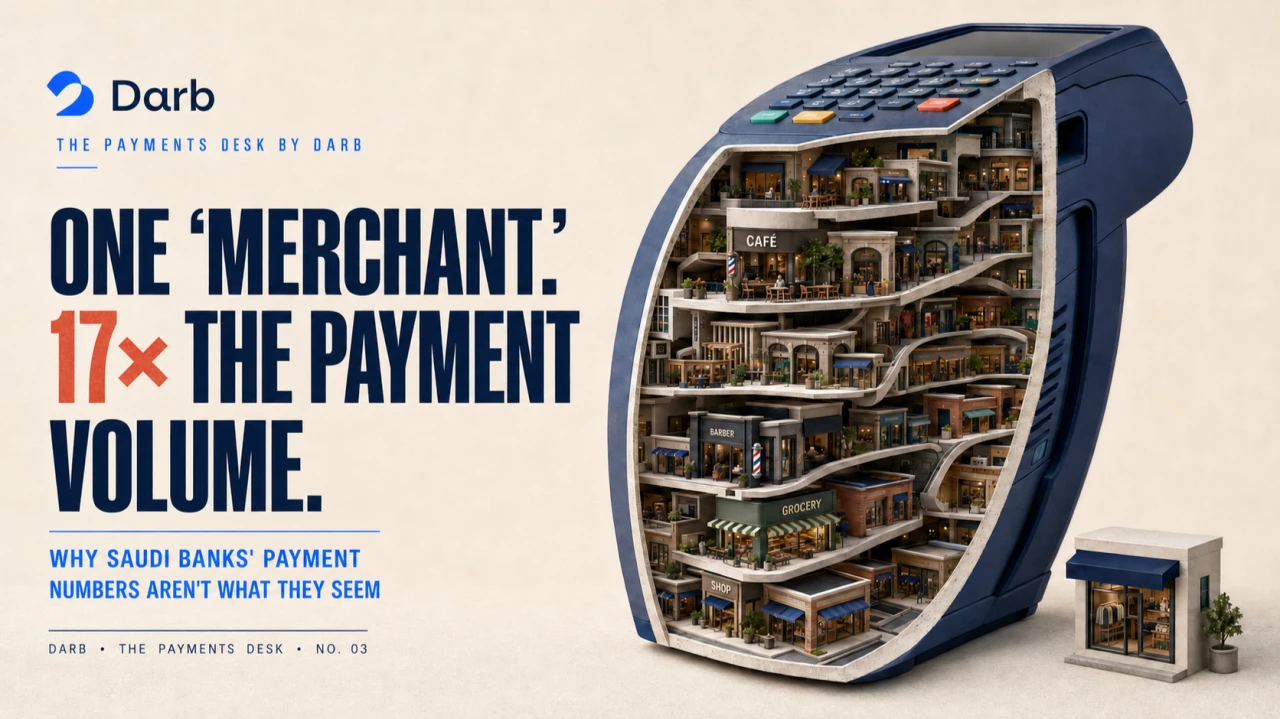
The average business banking with ANB runs SAR 8.5 million a year through its card machines.
The average business banking with Al Rajhi runs SAR 479 thousand.
Seventeen times apart. Same country. Same cards. Same rules.
My first thought was that ANB just has richer customers. I think that's wrong.
Annual card payments per reported merchant
2025 figures for six Saudi banks, ranked by average annual card payments per reported merchant.
The largest annual volume is approximately 17.6× the smallest in this six-bank sample.
View accessible data table
| Bank | Chart data | Value |
|---|---|---|
| ANB | Annual volume | 8,470,000 Saudi riyals / year |
| SAB | Annual volume | 5,560,000 Saudi riyals / year |
| SAIB | Annual volume | 5,100,000 Saudi riyals / year |
| SNB | Annual volume | 2,830,000 Saudi riyals / year |
| Riyad Bank | Annual volume | 760,000 Saudi riyals / year |
| Al Rajhi | Annual volume | 480,000 Saudi riyals / year |
Banks call these businesses "merchants." And I think that word is doing three completely different jobs in the same table.
At Al Rajhi, a merchant is a shop. A real shop. A barber in Malaz. A café off Tahlia. A grocer in Hail. Al Rajhi has 225,000 of them, and the average one takes about six card payments a day.
That's not a weak business. That's just what a small shop looks like when you measure it honestly.
At SAB, a merchant is a big company. International brands. Chains. The kind with dozens of branches. SAB signed up 40,000 businesses and handles 40% of all the money in the table. One line in that spreadsheet can be a company with 200 stores behind it.
At ANB, a merchant is often not a shop at all. ANB banks fintech companies. When a bank supports a payment platform, the whole platform counts as one merchant. Underneath it can sit thousands of businesses the bank never signed up itself.
So the table isn't comparing six banks doing the same job. It's showing three different businesses that happen to hold the same license.
Business share and spend share
Each bank’s share of businesses compared with its share of merchant spend.
Shares are shown as supplied. Business-share values sum to 100.1% because of source rounding; spend-share values sum to 100%.
View accessible data table
| Bank | Chart data | Value |
|---|---|---|
| ANB | Business share | 1.3% |
| ANB | Spend share | 7.6% |
| SAB | Business share | 10.4% |
| SAB | Spend share | 40.3% |
| SAIB | Business share | 0.8% |
| SAIB | Spend share | 2.7% |
| SNB | Business share | 9.7% |
| SNB | Spend share | 19.3% |
| Riyad Bank | Business share | 20.2% |
| Riyad Bank | Spend share | 10.7% |
| Al Rajhi | Business share | 57.7% |
| Al Rajhi | Spend share | 19.4% |
Once you see that, the market share numbers get interesting.
Al Rajhi has 58% of the businesses and 19% of the money. SAB has 10% of the businesses and 40% of the money.
Who's winning? Depends which number you were told to care about.
Then there's the one I keep thinking about.
These six banks have put 1,654,283 card machines into Saudi Arabia. Last year those machines took 3.04 billion payments.
That's five payments per machine, per day. Across this six-bank sample.
Al Rajhi alone has 992,000 machines. They average one and a half payments a day each.
Payments per terminal, each day
Daily payments per terminal across the six-bank sample.
National reference: 5.0 transactions per terminal per day. The bars show this six-bank sample, not the entire Saudi market.
View accessible data table
| Bank | Chart data | Value |
|---|---|---|
| SAB | Transactions per terminal / day | 38.2 Transactions / terminal / day |
| SAIB | Transactions per terminal / day | 13.4 Transactions / terminal / day |
| ANB | Transactions per terminal / day | 10.0 Transactions / terminal / day |
| Riyad Bank | Transactions per terminal / day | 7.4 Transactions / terminal / day |
| SNB | Transactions per terminal / day | 4.7 Transactions / terminal / day |
| Al Rajhi | Transactions per terminal / day | 1.5 Transactions / terminal / day |
I don't think that's a failure. I think Saudi treated card acceptance like roads. You build them everywhere, before people need them, and you don't ask every road to pay for itself.
It worked. Saudi doesn't have a card acceptance problem. Most countries do.
It does mean a lot of machines are sitting idle. And payments are slowly moving onto phones anyway.
But here's the part that stays with me.
SAR 558 billion went into Saudi businesses through these six banks last year. Across 390,000 shops and about 1.65 million card machines.
Getting money into a business here is world class.
Now ask how those same businesses spend money.
A personal card. A bank transfer. A photo of a receipt sent to the finance guy at the end of the month.
Every shop in that table also buys things. We built something excellent for money coming in. We built almost nothing for money going out.
Nobody has finished the second half. That's our vision.
More soon.
— Abdulmohsen